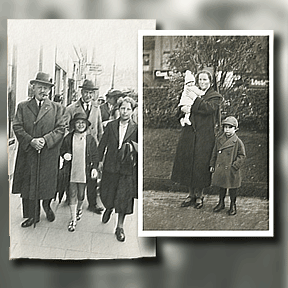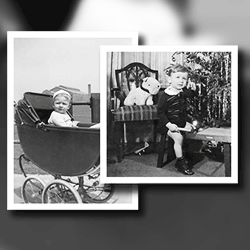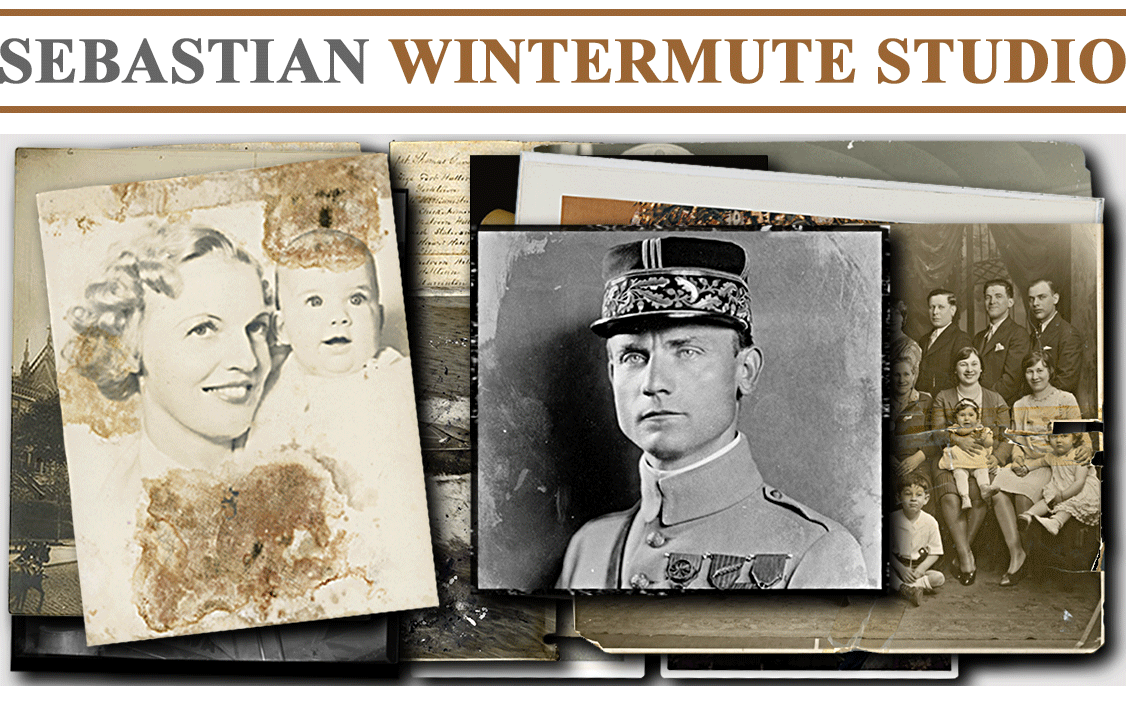
Expert photo restoration service for private clients, collectors, documentary filmmaking, archives, publishing, genealogy research, and all those dedicated to preservation of visual history.
For more then a decade Preserve Your Past has been providing expert photo restoration and photo retouching for photography collections and archives, publishing, documentary filmmaking and genealogy research services.
Preserve Your Past has rescued thousands of old photographs and faded pages, from camera obscura portrait of American settlers to NASA documents from the Apollo Moon missions; from Revolutionary War veterans land grant signed by the Founding Fathers to snapshots of GIs crossing the Rhine during the final months of WWII.
As an expert phot restorer he develop a loyal following of clients and restoration enthusiasts and has appear on BBC News where he discussed and demonstrated some of the his phot restoration techniques.
Most recently he had the pleasure of restoring photographs for the special edition of “Leave Your Sleep” album by Natalie Merchant, museum quality restoration and replication of dozens of historical photographs from Greek Orthodox Archdioceses of America and restoration of photographs of Triangle Shirtwaist Factory fire for Remember the Fire - HBO documentary special.
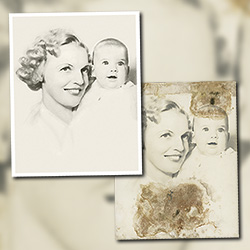
Photograph of Josephine Carlisi, one of the victims of the Triangle Shirtwaist Factory fire is one of the few images restored for the documentary movie dedicated to 100th anniversary of that tragic event.
Particular attention was giving to preservation of the authentic look of the image while careful reconstruction on the facial features brought back the appearance of a young and beautiful woman who among many others perished in the fire on March 25, 1911
Restoration of old photographs, particularly those of the loved ones who are no longer with us, can be a very personal and moving experience for many people. Sebastian appreciates that, carefully listening and following any suggestions and wishes expressed by clients and striving to fulfill all of their expectations and instructions.
Factors taken into consideration include the image's physical condition and shape (restoration of a rolled up photograph will require it to be flattened, stains and creases repaired, etc), and necessary requirements for a final print of a restored photograph. Based on that, an estimate is produced and the photograph enters the first stage of restoration process.
Photo restoration is a difficult and time consuming art form, especially when it comes to extremely damaged photographs on which important parts, particularly facial features, are missing. Even in such extreme cases artistic expertise and experience working with historical photographs allows for successful undertaking and completion of even the most difficult restoration projects.
Prices for photo restoration, photo retouching, photo scanning, photo archiving and printing services.
Restoration is an art not a science with reproducible results, each restoration project is unique.
An accurate estimates can be provided only upon thorough examination of the original and is based on a number of factors including clients requirements for the final image: size, tone, print quality and materials, even the lighting conditions where the restored photograph will be displayed.
Sebastian Wintermute strives to keep the prices affordable without sacrificing quality of service or materials. The usual cost of restoration of photographs ranges from $70.00 to $200.00 with justifiably higher prices for restoration of exceptionally damaged photographs, museum quality restoration and conservation or projects that require personalized service.
Free photo restoration, pro bono work and discounts are offered to survivors and families of victims of Holocaust and veterans of WWII.
To obtain an estimate, please make an appointment to have your photograph examined and to receive a comprehensive answers to any questions that you may have concerning all aspects of photo restoration, or
to receive a preliminary estimate you may e-mail a scan of the photograph
Preserve Your Past was privileged to restore document that are directly related to the history of our great nation; military papers signed by Abraham Lincoln during the Civil War, patrolmen nominations signed by New York Police Commissioner and future president,Theodore Roosevelt; World War 2 memorabilia as well as restoration of NASA documents flown to the Moon aboard Apollo 12.
Document restoration and conservation include a full range of treatments from the stabilization of fragile materials including surface cleaning and non-aqueous de-acidification to insure against further deterioration, reduction of creases, mending of tears and infilling areas of paper loss. Various options ensure the treated documents remain stable, including polyester film encapsulation, various archival folders and storage boxes.
Prior to beginning of document restoration, each document is examined and a written description of proposed treatments along with an estimated cost based on time and materials are submitted to the client. No restoration process is started until the client approves it. Before and after photos are taken for the final restoration report.
Documents too damaged for traditional methods can be restored digitally - the same procedures used in high quality photo restoration. A damaged document is scanned, digitally restored to good-as-new condition and printed on specialty paper for showcase quality copies.
Some situations require photo retouching services beyond the realm photo restoration. Because of the challenge and fun, Sebastian rarely turns away such requests, be it whether coloring of an old black and white picture or turning a digital snapshot into a sepia tone “vintage” photograph.
Applying color to black and white photographs adds a wonderful touch to vintage and modern photographs alike. Originally a very difficult and costly process involving application of oil paint and markers onto the original photograph, photo coloring has now become more affordable with the advances of digital photo retouching and allows a variety of colors and shades to be applied onto a digital image with extreme precision and without any possibility of damage to the original.
Growing interest in genealogy and preservation of family history sparked a high demand for archiving and sharing of old family photographs and documents. Unfortunately many companies that offer photo scanning services are not prepared to deal with fragile heirloom photographs and documents. Risks of loss or damages to originals are compounded when work is outsourced to offshore companies that use outdated equipment operated by semi skilled workers.
Preserve Your Past offers high quality photo scanning at a reasonable price. Each item is scanned individually eliminating the risk of damage that may be caused by an industrial automatic multi page scanners. Scans are manually color corrected as required, while minor dust and scratches are carefully reduced without lowering image sharpness or quality.
Photograph of Josephine Carlisi, one of the victims of the Triangle Shirtwaist Factory fire is one of the few images restored for HBO documentary dedicated to 100th anniversary of that tragic event.
Particular attention was giving to preservation of the authentic look of the image while careful reconstruction on the facial features brought back the appearance of a young and beautiful woman who among many others perished in the fire on March 25, 1911
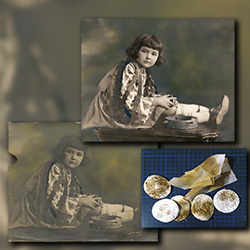
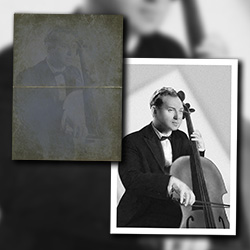
Victorian photograph of a young girl with her favorite doll was restored from a damaged, low contrast glass negative.
Restoration of this faded photograph began with making a high-resolution scan of the image. Photo Restoration Review and Client Testimonials is a step importance of which is often unrealized by amateur and discount photo restoration services. Ones scanned the image underwent the process of Photo Retouching to remove the fading, scratches and al other damages that the image accumulated over the years. After retouching the colors were applied to the restored image. Photo coloring used to bring back the original tones and hues before the photograph was printed on fine art paper.
Torn, folded and discolored group photo showing the elegance of 30s fashion was carefully repaired by putting together five separate pieces and removing all the signs of damage. The restored photograph was printed on archival paper using pigment inks.
1920's signed portrait of Native American warrior of Hopi Tribe wearing full ceremonial dress was carefully restored to remove all signs of damage and discoloration while preserving the intricate details of the outfit and the headdress. Giclée print of the restored image was made on fine art paper and framed with cream mat and a walnut frame to compliment the sepia tone of the photograph.
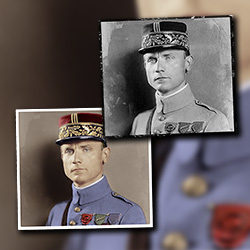
Portrait of WWI hero, Milan Rastislav Stefanik who co-founded Czechoslovakia in 1918 was restored from damaged 5x7 glass plate negative taken during the sitting for the official portrait. After the black and white photograph was restored it was colored, accurately replicating the colors of WWI French uniform and the military decorations as they were confirmed by extensive research and consultation with military history experts. Final image was printed on Moab Summerset Enhanced paper.
24x30 inch architectural blue prints were scanned on a large scanner. The accuracy and evenness of the high-end scanner is perfectly suited for scanning of oversize documents that are larger than most consumer or commercial type flatbed scanners. Various blueprint pages were assembled with pertinent data to create a montage. Background, stains and creases were digitally retouched, and final restored blueprint was printed on archival paper.
Shortly after Lindbergh's historic flight across the Atlantic, on July 4th, 1929 two daring aviators flew across the bay completing the first and only air mail delivery from Long Island to Fire Island. The photograph taken immediately after their landing was heavily stained and damaged by water and chemicals during a house fire. A bit of historical research was conducted during the restoration process to determine whether the appearance of the pilot in the center of the photo was natural or due to the damage to the photograph. It was discovered that the young daredevil did indeed suffer a broken nose in a car crash. After the photograph underwent digital retouching and restoration to like new condition it was printed on archival matte paper.
Early 20th century photo of American tourists posing in front of the Sphinx and the Great Pyramid, on a trip to see the wonders of the Ancient Egypt. Over the years the photograph faded ad suffered cracks and broken off sections. The photograph was careful retouched to remove all signs of the damage while preserving the original hue that came from the specific type of photo paper with blue clay layer that was often used in early photography.
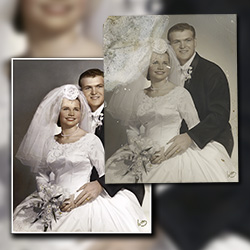
This beautiful wedding picture taken at the beginning of the 20th century was brought to the studio in separate pieces. In addition to tears parts of the photograph were missing and the photograph was extremely faded and showed signs of silver migration. All the tears and missing areas were restored and replaced through careful retouching to produce prints that contained all the detail and richness of the original.
Hand colored photograph showed extensive flaking of the oil paint and photo emulsion. The missing facial features presented a real restoration challenge but were successfully restored by interpreting shapes from additional photos of the graduate. A 16x20 high quality color print was produced from the digital file and framed as an anniversary gift years after her original picture was taken.
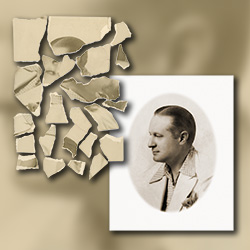
This beautiful photograph of a woman was taken in the early part of 20th century. Over the years it suffered chemical discoloration and flaking of the photo emulsion and paper. Careful retouching of this old photograph removed the chemical cast and filled in the missing areas. A new oval frame was added to fill a standard 5x7 inch frame.
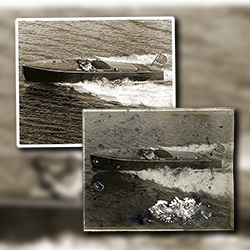
The photo of a vintage Chris Craft speedboat racing across Long Island Sound was affected by chemical deterioration from improper photo processing, at some point of time it also became covered with ink spots and numerous scratches. During the restoration the ink spots and other damaged areas were carefully retouched and realistic water and waves were added to recover the feeling of speed and beauty conveyed by this photograph.
Old photograph of a village winter scene was missing major parts of the image and decorative border. The photograph was repaired by replicating the intact parts of the decorative border and cloning torn off pieces from the existing image. After the photo restoration was complete, the picture was printed on archival paper with sepia tone added to give the new image the appearance of vintage photograph.
This 1960s color photograph became faded and discolored from the exposure to the direct sunlight. During the restoration the color balance of the photograph was adjusted and fading was reduced to bring back the original colors. We didn't try to change the 1960s style of this photo, just bring it back to as new condition.
Careful digital retouching and adjustment of contrast levels were required to retain the detail and to revive this vintage photograph of two "athletes" standing next to a swimming cabin. Following restoration an 8x10 archival print was made from the high-resolution digital file.
This oil-tinted portrait of a woman had an uneven cut off border, missing parts, paint stains, major creases and flakes. The photograph was digitally retouched to remove signs of damage and the color balance was enhanced to simulate the original look of photo paper used in the 1950s.
A low contrast and faded portrait of father and son was digitally fixed to reveal the personalities of the two gentlemen and the appearance of World War 1 Italian army uniform.
After completion of the restoration and enhancements, a warm toned high quality photo print was made on archival matte paper.
A badly damaged and fire burned photo of two shopkeepers with a substantial amount of obliterated information required an extreme restoration including replication of burned off background and text.
The original 1887 NYPD patrolman nomination document signed by future President Theodore Roosevelt was brought to our studio in the state of high deterioration. Glued to a cardboard, it was wrinkled and yellowed with the signature of Theodore Roosevelt barely legible.
Because any attempt to separate the document from the mounting board could lead to destruction and any application of cleaning solutions may react negatively with the mounting glue, digital replication and Document Restoration was the only option available. The document was scanned at extremely high resolution to protect the intricate detailed of the engraving and handwriting.
The discoloration was removed by careful adjustment of the color balance and all details in the document were carefully retouched. The signature of the future President Roosevelt was enhanced to make it legible once again. The final image was printed on archival matte paper to be framed and displayed.
Possible exposure to chemical cleaners caused a yellow stain to cover most of this valuable signed photograph of the famed boxer. To preserve the value of the signature, a high resolution digital copy of the photograph was produced and then retouched to remove all appearances of the stain. The restored image was printed on the high quality photo paper and framed, with the original signed photograph safely sealed in an archival envelope placed under the protective back cover of the frame.
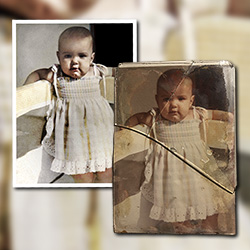
Every child thinks that he or she is the next greatest artist. Unfortunately some of their creative experiments take a heavy toll on whatever comes under their magic markers. This oil tinted baby picture that underwent additional coloring at the hand of 5 year old artist was carefully retouched to remove all signs of flaking of the original pigments as well as the magic marker colorization that was generously applied to the hair, eyes and the baby outfit. The restoration of the eyes presented a particular challenge since it was important to recreate the impression of true baby innocence.
A beautiful photograph of young ballerinas reminiscent of impressionists' paintings was heavily affected by chemical deterioration, exposure to dust and mechanical damage that resulted in missing parts at the corners of the picture. The photograph was retouched to even the tone of the background, missing areas were carefully filled in and overall correction of color and brightness was applied to the final image.
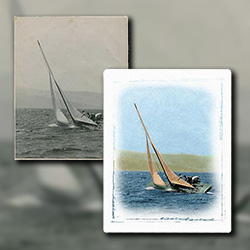
This black and white photograph taken in early 1950s was carefully colored using advanced digital painting techniques.
The colors were applied to the photograph according to the best recollection of the client who was one of the young men sailing the boat across a lake in Upstate New York.
A decorative border was added the the photograph adding vintage appearance and a bit of a nostalgic touch.
A wonderful example of pre Civil War portrait was created with help of camera obscura where the image is first traced on a piece of paper laid over the ground glass of the camera. This technique was very popular at the time when photographic process was still extremely difficult and very expensive.
During restoration the portrait was scanned at high resolution and retouched to remove all the signs of tears and stains. Fully restored and printed on high quality archival photo paper this portrait became a great addition to the collection photographs and images of family history spanning for over 150 years.
This beautiful hand colored photograph of a girl was found in the attic were it was neglected for many years. The owner became aware that silverfish had attacked the paper just in time for us to fully restore this precious portrait. With exceptional attention to detail the facial features of the portrait were retouched and the missing parts of the background were carefully painted in. After the restoration of the photograph was complete, the image was printed on fine art paper.
Digital restoration of documents provides an opportunity to bring back even the most damaged pieces. This document dating from 1899 was torn in four parts, showed fading and discoloration, had missing parts and sections were covered by adhesive tape. To restore it to its original appearance, a high resolution scan was made of the individual pieces which were then assembled into single digital file.
After the pieces were aligned digitally and joined together, all the seams were carefully retouched and the missing parts were copied from the undamaged areas or painted in. Finally, the overall colors and tones of the document were adjusted to restore it to its original condition.
This vintage photograph is a great example of a photo portrait that had paint applied to it to create the appearance of an oil painting. Over the years the portrait became heavily creased with parts of the paint layer and photo emulsion separating from the base. The image was carefully retouched to remove all signs of damage and adjusted to bring back the tonality and contrast. Final print was produced using a high quality photo printer and Giclée matte paper.
Photographs dating back to the Civil War often exhibit fading, chemical deterioration and silver migration. Each of those images deserves careful consideration and preservation because of the historical significance that the are depicted on those photographs.
This striking photograph of three solders wearing cavalry uniforms required extensive restoration due to its uneven fading. Careful application of dodging and burning techniques and precise matching of tone and contrast helped to bring back the natural appearance of this Civil War cavalry group photo.
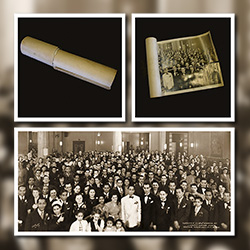
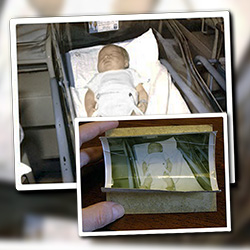
Restoration of a rolled up documents or a photograph is considered to be one of the most challenging and difficult of all restoration tasks. Because simply trying to unroll the photograph may case additional damage if not total of the item, first the photograph has to be carefully humidified in order to introduce moisture into the layers of the photo paper and make it pliable. Often the procedure of humidification has to be repeated many times with the photograph being carefully unrolled inch by inch.
This particular photograph was not only rolled and stored that way for many decades in a dry environment, it was also broken by careless mishandling. Fortunately the tear run only half through the photograph and no parts of the photograph were missing.
After the humidification, unrolling and flattening of the photograph were complete, the photograph was digitally scanned and retouched to remove all signed of damages. Light sepia tone was applied to the photograph to gave the final image a delicate vintage appeal.
The final image was printed on fine art semi gloss paper to be framed and displayed by the owners of the original photograph.
An early 20th century photo of one of the many beautiful churches that grace 5th Avenue of New York City suffered from substantial fading and lack of contrast in the dark tones. After general clean up of the image, masking was used to select shadow areas for adjustment in contrast and tone.
A fine art quality print was made from the restored image. It is part of a large collection of historic photographs of New York that were restored by Preserve Your Past restoration studio and displayed in New York City prestigious social clubs.
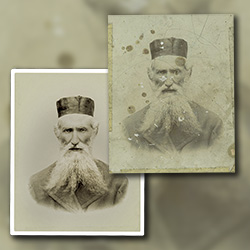
This 1880s photo of a Rabbi was restored publication of a book on Jewish history.
The photograph was carefully retouched to remove creases, scratches and mildew stains. The missing areas were digitally painted in and the Rabbi's signature, stamp and wax seal were added to complete his legacy. Slight sepia toning was added to give the restored photo a vintage appearance.
This extremely rare and valuable 17th century antique map of London printed for and dedicated to Sir Robert Vyner (Viner), Lord Mayor of London (1674), had suffered cuts and scratches from broken glass when the frame was damaged during shipping.
After removing the map from the frame and detaching it from the mounting board the map was carefully cleaned from any traces of broken glass and deacidified to prevent further deterioration that occurs from exposure to chemicals. The tears were carefully repaired and filled in with a pH neutral compound and all signs of damage were eliminated with outmost care.
After the restoration of map was completed, only those who knew the original location of the damaged spots could identify the repair. To complete the presentation, the map was placed on museum quality mounting board and covered with custom cut mat.
The restoration of this photograph consisted of removal of fading, overall adjustment of color and saturation to bring back the richness of tones and filling in of missing parts. The final image was printed on archival paper and sized to fit a standard photo frame.
Need a modern day photo turned into a vintage photograph that would look great in an album or used as part of historical presentation?
Our "Photo Antiquation" can convert a modern color or digital photo to a black and white antique. Giving a vintage look to a modern photograph, applying scratches, discolorations, tears, fading and any number of other marks gives a photo a look of days gone by. We'll run it through a wash cycle if you'd like.
This picture of 1914 Avro 504K airplane was taken with cheap digital camera during an air show at Old Rhinebeck Aerodrome and then given a vintage look by applying sepia tone and adding an old style photo border.
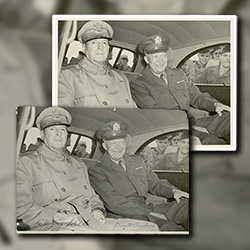
Particular care was given in making a copy of this exceptionally rare autographed photo of World War II heroes, General MacArthur and General Eisenhower taken during their meeting.
After removing all signs of staining and filling in the missing areas, special attention was given to the reproduction of detail and color of the signatures. The bottom border texture and color were extended around the photo to recreate the original size of the print.
Fine art Giclée photo paper was used to print the image that perfectly matched the signed original.
This 19th century vintage photo of the landmark Dakota building on Central Park West and 72nd Street in New York City predated the arrival of automobiles and shows the Upper West Side at the time when most of it was occupied by small farms and plots of waste land.
Restoration of this photograph for The New York Metropolitan Club started with making of a high resolution 1200 dpi scan. Fading was reduced and chemical stains were eliminated. Finally, after the photograph was restored to like new condition a 16x20 print was made on gallery quality paper.
Taken at the end of 19th or beginning of 20th century a formal photo portrait shows Russian officer wearing a parade uniform of the Imperial Guard regiment, displaying a golden sword with which he was decorated for personal bravery in combat.
The photograph was carefully retouched to remove the overall fading and minor scratches. Following the retouching the photograph was lightly colorized to show the splendor of the uniform and the award decoration.
A 19th century photograph of the famous New York Plaza Hotel required careful cleaning and retouching of some missing parts of the building and it's surrounding.
After the retouching was complete, light colorization was applied to the photograph to eliminate the vast stark area of the sky. The subtle tones of blue and yellow gave the final image a delicate vintage appeal.
This late 19th century photograph of 5th Avenue and the old 42nd Street Reservoir (present location of New York Public Library) was a faded ghost of its original self.
During the restoration the overall fading of the photograph was removed and contrast and richness of the tones were brought back. The final restored image was printed on premium photo paper to be displayed as part of the collection of New York historic photographs.
Measuring over three feet across this extremely rare 1899 panoramic view of Lower Manhattan and the South Street Seaport taken from the Brooklyn side became unevenly faded and discolored with age.
The photograph was copied using a large format camera equipped with a high resolution digital scan back and a German made Schneider flat field lens. After careful retouching and restoration, the photograph was printed on wide format Giclée printer and displayed as part of waste New York historic photographs of one of the most prestigious social clubs.
The famous intersection of 5th Avenue, Broadway and 23rd street is a renowned for many of its historical landmark sights, monuments and buildings including the Flatiron Building, the former Fifth Avenue Hotel and Madison Square. On this beautiful photograph taken in 1903, the trolleys can be seen running along the Broadway line and horse drawn carriages are making deliveries to the busy mid-town businesses.
Sections of the original photograph were missing and it was showing uneven fading, but excellent quality and sharpness allowed the photograph to be restored to its former beauty. A large size Giclée print was made from the final high resolution digital file.
The view of New York's City Hall was captured on 1885 historic photograph taken on the day of President Ulysses S. Grant funeral. With the building draped in black and the flags lowered, the funeral procession can be seen coming down the steps of the building.
The photograph was scanned at high resolution and the image was digitally restored to bring back the richness of details. After the restoration was completed a print was made using high quality Giclée photo paper. It was to be framed and displayed as part of the historic photographic collections of one of New York's most prestigious social clubs.
Since 1903 the famous intersection of 5th Avenue, Broadway and 23rd Street is the home of renowned Flatiron Building. Before it was built this was the scene what visitors would see looking at the intersection from the Madison Square.
The photograph was carefully retouched and levels and contrast were corrected to bring back the richness of tone. A large size museum quality archival print was produced from high resolution digital file.
The photograph of fencers from the 1912 Stockholm 5th Olympic Games shows members of New York Fencers Club including the future general George S. Patton.
With years, the photograph has faded and yellowed from age and water damage, blurring the title and the names of the sportsmen. The photograph was carefully retouched to remove the fading and color cast and the new titles were added, correcting the misspelling of some of the names.
Dealers, owners, collectors and restorers of rare vintage cars often require copied of a build sheet and other documents to show the parts that went into the original car.
During this restoration project, a duplicate was created of an oil stained, torn and barely legible build sheet for a very rare 1968 Mustang Shelby Convertible.
All information was replicated with matching type fonts and colors. Printer paper with sprocket holes was used for authenticity.
Photographs with missing or damaged facial features present a tremendous challenge for even the most skilled photo restorers. The expression of the eyes can change dramatically from just the slightest change in pattern or light. A few misplaced pixels can render the face of the person in the photograph as almost unrecognizable.
In restoration of this portrait, extreme care was taken to restore the damaged areas of the eyes and faces. Careful blending and shading was applied to make the faces look natural and the eyes to look real. The final image was printed on high quality fine art paper with a slight sepia tone to preserve the look of a vintage photograph.
This striking early 20th century portrait of a Rebbe from Eastern Europe was one of many that were brought in by those who strive to preserve and protect Jewish heritage.
The original photograph was heavily stained by chemicals and mildew and exhibited many marks and scratches from age and mishandling. After producing a high resolution scan, the photograph was digitally retouched and restored to its original appearance including the tone of the blue clay photo paper popular in late 19th, early 20th century.
A wonderful photograph printed from a still shot taken on the set of an early Hollywood movie had suffered many tears, scratch marks and missing parts of the emulsion.
Careful digital photo restoration included a combination of cloning and painting in techniques. Contrast adjustments were selectively applied to bring back this memento of Hollywood glamour.
Since it was first presented to the veteran, this Civil War anniversary military discharge certificate listing all the engagements, regiments and commanding officers under which the person served, suffered tremendous amount of damage. It contained missing parts, damage from soot, creases, tears and chemical stains from an attempt to piece the document together with masking and clear adhesive tapes. It was clear that digital restoration of document was the only option to save this challenging piece of historical significance.
The document was photographed using a large format camera equipped with high resolution digital scan back and a super sharp German made Schneider flat field lens. The most intricate details were scanned at an extremely high resolution and careful retouching removed all signs of damage to the document and missing parts were replicated and filled in. The final image was printed on archival matte paper to duplicate the size, appearance and the feeling of the undamaged original document.
An award certificate from the American Games is a great example of sports memorabilia restoration. The repeated folding caused tears along the seams and clear tape was used to piece it together resulting in extensive chemical damage to the document. In addition the top of the document was missing completely.
The extensive damage required digital restoration as the only option to save this document and make it possible to display. The background was cleaned and all tape residue and minor damage were retouched. The missing areas were filled in and the top of the document carefully painted in.
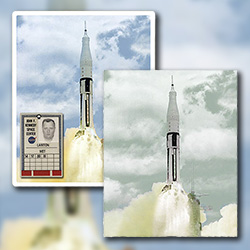
A photograph of Apollo 8 mission lift-off was sent along with the NASA ID card belonging to one of the engineers who worked on the NASA space program.
The heavily faded print was restored to bring back the richness of color in the sky and rocket flames. The ID card was added with a drop shadow to complete this keepsake for framing and display.
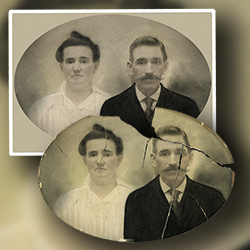
This portrait of husband and wife was part of collection of Irish American family visual history spanning for well over 150 years.
The portrait was brought to our studio in six separate pieces and the client was doubtful that anything could be done to save this precious heirloom.
A high resolution scan was made of each separate piece which were later assembled into a single image using advanced image manipulation techniques. All signs of the tears were carefully retouched and the image was corrected to eliminate signs of discoloration and stains. The restored portrait was printed on archival fine art paper in different sizes ranging from a one-to-one match of the original (approximately 11x16), to 5x7s to be framed and given as presents to the members of the family.
A Civil War US Navy Captains Commission signed by President Lincoln was sent to our studio in dire need of restoration. The document was mounted in a cheap frame with broken glass and over the years the velum on which document was printed and written became warped and infested by mold and mildew.
After careful removal from the frame, the document was deacidified and cleaned to prevent any further chemical deterioration and infestation. The appearance of stains was reduced as much as possible with particular attention given to preservation of President Lincoln' signature. Following careful flattening of the document it was mounted on archival board with mylar corners, covered with a custom cut mat and framed in an elegant gallery molding.
The official photograph of Antarctic Oceanographic Research Ship USNS Eltanin taken during of expeditions and bearing the imprints of the official emblem. The photograph was badly damaged and suffered from chemical discoloration, numerous tears, creases, missing parts and an attempted repair with clear adhesive tape (never a good idea).
Restoration of this photograph began with production of a high resolution 1200dpi scan followed by digital retouching and removing of the damage. The imprints of the expeditions official seal were cleaned and the smudges removed. Finally the image was printed on high quality paper matching the size of the original photograph.
One of the few official NASA documents that were flown to the Moon on board of Apollo 12 mission and signed by Lunar Module Pilot Alan L. Bean.
Part of a private space memorabilia collection this document printed on extremely thin velum which was treated and sterilized by NASA prior to the mission launch. With time the document began to display slight warping of the surface and exhibited minor tears and signs of discoloration.
The document was carefully cleaned and deacidfied to prevent further chemical deterioration. The tears were patched with an archival pH neutral compound and was flattened to reduce the appearance of warping.
This beautiful portrait of legendary acting coach, Stella Adler perfectly illustrates what happens when a photograph is exposed to household cleaners. The chemical burn damaged the photo emulsion of the Cibachrome print creating an ugly stain and discoloration over the entire picture.
Fortunately the face on the portrait was not damaged and careful retouching removed the stain and recreated the damaged details of the photograph. Brightness and contrast were corrected to bring back the vibrant colors and the final image was printed on archival paper and framed under glass to protect the portrait from any future accidents.
A large print of this lovely sweet sixteen portrait was brought in with obvious cracks, missing parts, and localized discoloration.
High resolution scan retained all the original detail and color accuracy. After restoration an archival 20x24 inch print was produced that was framed and displayed by the delighted subject of the photo years after the original photograph was made.
This unique photograph of a rare black swan was reminiscent of an impressionist's painting, but the original print was very faded and most of the color was absent.
Digital restoration involved adding contrast and bringing out color in the same subtle style of impressionist masters. An archival Giclée print was made on canvas to further simulate the painterly feel.
Shifts in color are most often the result of extended exposure to the harmful effects of the sun. Extreme cases will eliminate all highlight detail, requiring replacement from other sources, if available.
This photo of a multigenerational family gathering also had missing sections that had to be digitally drawn in. The color adjustments required masking of many different areas because of an unevenness of color shift in each hue. Missing parts were replaced and the resulting archival print looked new once again.
This heavily faded photo of 1963 New York Yankees baseball team, was owned by the former bat boy who was lucky enough to have the photo signed by every player on the A.L. championship team. It is likely that the photograph was framed and exposed to sun damage over time, then rolled up and put away in a manner that resulted in cracking and damage of photo emulsion layer.
The color was enhanced to match the hues of old Yankee stadium. Surface cracks on the photograph were eliminated in all areas including the faces of the team players. An archival print was produced on fine art luster paper and framed for display.
Torn, extremely dried, and wrapped into a tight roll, this document presented a real restoration nightmare. The first step in bringing this document back was reintroduction of humidity in to the paper in order to make it pliable enough to be unrolled.
After the unrolling, the document was carefully flattened, cleaned and stabilized to prevent any further deterioration. The tears and the missing sections were filled and reinforced with pH neutral archival material. The document was then ready to be framed and displayed.
Many documents printed and written on parchment and vellum may become warped and shrunk if not properly stored and protected.
This diploma dating to 1920 became damaged and infested with mold and mildew due to long exposure in area of high humidity. Restoration of diploma started started with careful cleaning of the surface and the document was treated to kill any spores and to reduce the appearance of mildew. It was also humidified to make the material pliable and then carefully flattened and dried to remove the warping. Up to 2 inches in dimension were gained back through this process.
Restoration of this Civil War document presented a real challenge since it was not only heavily faded and discolored but in addition to regular teas that can be expected on such old document it two layers of paper tape were applied at different times to prevent the document from separation at the folds.
The document was carefully cleaned and deacidified to prevent further deterioration and most of the tape was removed to reveal the text hidden underneath. Since the dirt that became imbedded at the folds of the documents could not be removed completely, a digital copy of the document was made and retouched to create a display copy that could be framed and showcased in place of the original.
The restoration of this photograph, and many others from the early part of the 20th century was commissioned by the New York Racquet & Tennis Club, one of the oldest and most prestigious sport clubs in the country.
The photograph was heavily faded and discolored with the corner of the framing mat completely torn off. It was carefully restored to remove the uneven fading and to sharpen and brighten the accompanied text.
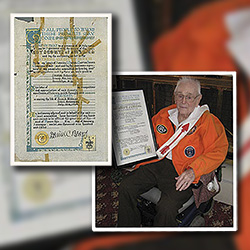
Commissioned by The Ten Mile River Scout Museum, this 1930 Boy Scout award for saving a man from drowning was carefully restored to be presented to the original recipient on his 95th birthday.
Each damaged or missing letter on the award was meticulously retouched and all the damaged areas were carefully restored and replicated. The final print was produced on Giclée final art paper to match the appearance of the original document.
The rare Civil War Union Army Discharge document was very faded with much of the text written in iron gall ink lost or made unreadable by creases and stains. What made this document so unique was the list of battles and skirmishes that the soldier fought in, written on the back of the document. The document was carefully cleaned from accumulated dirt and degree. A replica of the document was created by making of a high resolution scan of both sided followed by retouching and recreation of missing text. Giclée prints of the document were printed on fine art matte paper that matched the texture of the original and trimmed to follow the outlines of the original.
I would just like to let you know how truly impressed I am with the outcome of the restoration services you provided. When I submitted my Civil War Discharge document I was nervous as this is a family treasure, thus very important to my family. Not only is the original restored and preserved magnificently, but the replication of this document is truly amazing. It mirrors and captures the look and feel of the original work. Without fail, it exceeded my expectations.
Furthermore, you frequent updates and research of this document during the period you preformed the restoration process was far more than outstanding. It allowed me to relax while my family relic was in your trust and care.
The work is simply beautiful and I know that it will be admired by friends and family for years to come. You have a customer for life!
Thanks,
Mike H.
1942 The Halifax Chronicle newspaper describing an amazing story of WW2 rescue of Canadian merchant marine who survived three sinking of merchant ships torpedoed by German submarines.
Restoration of the newspaper began with careful humidification and flattening of the pages. After humidification the newspaper was unfolded the surface of the paper was cleaned from accumulated debris. Numerous tears and missing areas were reinforced and patched with archival backing material. To prevent further deterioration the paper was deacidified to neutralize any harmful chemicals that were originally contained in the paper and those that accumulated on it over the years.
High resolution scans of the pages were made using large format flatbed scanner and the produced digital images were retouched to remove the appearance of discoloration, rips, tears and other damages. The missing text was copied from a copy of the newspaper obtained from the newspaper archive. Particular attention was given to matching the typeface and the appearance of newspaper print.
The restored image was printed in full size on archival paper given along with the digital file to the son of the sailor. The restored image was used as illustration in a book about this episode of WWII Arctic Convoys.
With time many Polaroid pictures become discolored, cracked and curled. Scratches and tears may result in separation of layers that cause further damage to the image. Such Polaroid pictures have to be restored with extreme care.
Since attempting to scan a Polaroid photograph in such state of distress may result in poor quality of image and in worst case further damage and even destruction of a photograph, first step in restoration has to be humidification and flattening of the photograph. By slowly introducing humidity into the layers of a photograph it can be uncurled and made pliable ones again. Quite often the process of humidification and flattening has to be repeated many times before a photograph becomes reasonably flat.
Ones a photographed is flattened and dried it is scanned at high resolution to produce a digital file suitable for restoration. After the the photograph is scanned image is carefully retouched to remove any signs of damages, such as scratches of the photo emulsion, tears and rips. Color correction is applied to restore the original tones of the photograph.
After that the final image can be printed on variety of available glossy photo papers. The most recommended is LexJet Sunset Photo Gloss paper that offers excellent ink retention characteristics and longevity with high gloss finish that resembles the original Polaroid prints.
This two photographs of poets Lydia Huntley Siguorney and Gerard Manley Hopkins are from a large series of images restored for the album "Leave Your Sleep" by Natalie Merchant.
The album based on poetry written for children or by children is accompanied by a booklet containing the texts of the original poems, biographical notes abut each author, and photographs from national, library, and private archives.
Each photograph was restore so not only it could be printed in the albums booklet, but also displayed on on a screen during live concert.
Photograph of Lydia Huntley Siguorney
by Matthew Brady -
Library of Congress, Prints & Photographs Division, LC-DIG-cwpbh-02747
Photograph of Gerard Manley Hopkins
by Forshaw and Coles Professional photo restoration, document restoration and preservation services
for private and corporate clients, family history and genealogy research enthusiasts.
Sebastian is a wizard. He can turn back the hands of time when he restores photographs.
Natalie Merchant
I would just like to let you know how truly impressed I am with the outcome of the restoration services you provided. When I submitted my Civil War Discharge document I was nervous as this is a family treasure, thus very important to my family. Not only is the original restored and preserved magnificently, but the replication of this document is truly amazing. It mirrors and captures the look and feel of the original work. Without fail, it exceeded my expectations.
Furthermore, you frequent updates and research of this document during the period you preformed the restoration process was far more than outstanding. It allowed me to relax while my family relic was in your trust and care.
The work is simply beautiful and I know that it will be admired by friends and family for years to come. You have a customer for life!
Thanks,
I am the recipient of one of your works of art. For Christmas, my fiance gave me a restored poster of my Dad, the poster was probably 40 years old. It was tattered, torn and generally in bad shape. It was a goofy poster of him at the grand opening of his then Enco station in Bishop, Texas. Anyway, the poster meant the world to me, especially since he passed unexpectedly in 2001. When I saw the restored poster yesterday, tears streamed down my face from the emotion of what my fiance had done as well as the unbelievable job you did recreating that poster to look brand new. It took me back 40 years! I don't know how you do it, but it's impressive. I will recommend you to anyone. What a wonderful way in which to honor and remember our loved ones! Thank you for making my Christmas present extra special. I will remember you as I come across other photos. Thanks again and Happy New Year!
Sincerely,
Melody
During the production of our latest documentary we came across a cache of old negatives that were integral to our film. Some of the negs were 35mm, others were antique glass plate originals; some were black and white, some were color... unfortunately all were heavily scratched and in sorry shape after years of ill care.
Thankfully Mr. Wintermute and Preserve Your Past beautifully restored these priceless images to broadcast-quality and infinitely enriched our final piece. They are truly a first rate studio.
Producer
Homespun Films
For a free estimate on photo restoration send a scanned copy of the photograph to be restored, or make an appointment to have it examined at the studio.
If possible submit high resolution, JPG files. Files saved at low resolution, or saved in any other formats may be rejected because of insufficient in quality.
Please indicate restoration, retouching, enlarging, and printing and any specific concerns.
Avoid naming files as "Grandpa and the baby". It is recommended that you use combination of your name and the current date and always use the file extension. Example: john_smith_10_10_2002.jpg
NOTE: Estimate on restoration of documents can only be provided after the review of the actual document, not from a scans.
Questions about photo restoration. How much photo restoration costs, how it's done and what to expect?
How long does it take to restore a photograph?
In most cases it takes between 5 to10 business days to have a photograph restored. However, if a photograph is extremely damaged of is extremely large the restoration may a bit longer.
There are seasonal considerations where volume increases turnaround time. Clients are advised to bring in the photographs to be restored well in advance of holidays such as Veterans Day, Mothers Day, Fathers Day or Christmas. There are no “rush” jobs, but quality work can be expedited at a higher rate to meet clients deadline.
How much does it cost to restore a photograph?
Photo restoration is an art not a science with reproducible results, each restoration project is unique.
An accurate estimates can be provided only upon thorough examination of the original and is based on a number of factors including client’s requirements for the final image: size, tone, print quality and materials, even the lighting conditions where the restored photograph will be displayed.
The usual cost ranges from $75.00 to $300.00, depending on complexity of required restoration, with justifiably higher prices for restoration of exceptionally damaged photographs, museum quality restoration and conservation or projects that require personalized service.
Pro bono work and discounts are offered to survivors and families of victims of Holocaust and veterans of WWII.
To obtain an estimate, please make an appointment to have your photograph examined and to receive a comprehensive answers to any questions that you may have concerning all aspects of photo restoration, or
to receive a preliminary estimate you may e-mail a scan of the photograph.
Can I send you a scan of photograph to be restored?
If you are unable to bring a photograph to the studio or send it to be restored you can e-mail a scan or send a CD with high resolution scan file. Please have a photograph scanned at minimum resolution of 300dpi (600dpi or more if photograph is to be enlarged) at full color setting, even if photograph is black and white.
However, please remember that producing a high quality scan is the first and one of the most important steps in photo restoration. Unlike many discount photo restoration services that use low quality scanners in hope that later whatever imperfections of the scan, low resolution or color changes can be fixes in Photoshop, Sebastian Wintermute utilizes high quality equipment to ensure capture of even the smallest details or the most minute color variations of the original that are needed for high quality photo restoration and art replication.
To see the difference in quality of images produced with professional high resolution photo scanners comparing to images produced by a common scanner you can examine the two scans of the same photograph.
Both scans were made at 600dpi resolution.
The scan on the left was made with a common all-in-one printer/copier/scanner.
The scan on the right was made with a calibrated photo scanner set specifically for high quality output.
The photo scanner result is much sharper, has better color balance and saturation. Magnification shows even the smallest details while the other scanner blurred details.
I have a document signed by one of the President of the United States but the signature has faded. Can you make the signature visible again?
Yes, a high quality reproduction can be produced with the signature and all other details restored to their original appearance. Please note: Your original will not be altered, as that would compromise its value and authenticity.
Can you fix a photograph that is covered with some sort of silver residue?
Many of old silver gelatin prints show signs of “silver migration” or “silver mirroring”. If a photograph was not properly processed, over time, some of the silver ions begin to migrate creating a shiny layer.
Unfortunately little that can be done to remove this layer. Some photo restorers use a light coating of Vaseline to reduce the appearance of silver migration, however this may irreversibly damage the print. Sebastian Wintermute has successfully restored “silver mirroring” damage to historically significant photographs by expert retouching of a high quality scan of the original.
Can you restore the original photograph instead of making a digital copy?
Traditional photo retouching service is offered on case-by-case basis. If an original photograph is damaged only slightly, it may still be possible to reduce the appearance of scratch marks and other imperfections by careful application of retouching spot tones.
The great misconception about photo restoration is that in the old times the true photo restorers whose art is forever lost, were able to repair and restore an original photograph to a pristine condition no matter how damaged it was. Nothing could be further from the truth. Though some damages such as scratches, minor blemishes or tears in the original photograph could and still can be retouched and repaired by a skilled restorer, anything more then that required making of a copy of the original photograph. The usual procedure was to photograph the original image onto a special copy film such as Kodak Professional Copy Film 4125 that was designed for retouching. After a copy was made the photo restorer would carefully retouch the negative removing all visible signs of damages and imperfections by applying special retouching tools and pencils. After the negative was retouched it would be printed on photo paper, this producing a restored duplicate of the original photograph.
Nowadays, instead of making a negative from the original photograph a digital file is created by scanning the photograph with a high quality photo scanner. After the digital file is retouched the restored image is printed on specially designed paper of higher quality and longevity then most of old fashion photo papers.
Can you enlarge a small photograph?
Yes, unless a photograph is very damaged or blurry or out of focus. Most passport size or wallet size photographs can be enlarger to 4x6 or 5x7 size and the photographs of those sizes can be enlarged to 8x10 or 11x14. A greater increase in size may result in loss of detail and excess appearance of film grain and texture of the original photograph.
Is it possible to remove a person from a photograph?
With careful photo retouching any object or a person can be removed from a photograph without making the resulting image composition appear artificially changed. Backgrounds can be removed, subjects can be placed in different settings as well. Lighting can adjusted to reveal details obscured by shadows. Sebastian Wintermute will alter photographs private use only. No retouching or alteration will be done to photographs to be published or to any images of historical significance, which may constitute a breach of professional ethics or the law (i.e. criminal or intellectual property).
How do I protect photographs and documents from fading?
To prolong the life of your photographs or documents and prevent additional damage, store your originals in archival acid-free envelopes and boxes that can be purchased at most art or frame shops.
Keep them where temperature and humidity will be consistent and avoid storage in garages, attics, and basements or near fireplaces and windows. Display the photographs or documents only in frames that are covered with UV protective glass. Keep them away from exposure to direct sunlight, fluorescent light. If your photographs or documents are mounted in frames, do not use chemical cleaners or solvents on the protective glass or the frame.
Chemicals may penetrate the openings between the glass and the frame and cause damage. Use only clean rags or paper towels with water to clean frames and glass. If a frame or a glass is damaged take it to a professional framing shop for repair, specifying the use of archival materials such as natural pH neutral mats and boards and UV protective glass.
How long do the digital prints last?
All photographs and documents restored by Sebastian Wintermute are printed on fine art archival papers using specially formulated inks. With proper care and display photo prints may last for over 150 years. If your restored photograph or document does become damaged, a new print made from an archived digital file by without the cost of the original restoration. The digital copies of your original and restored images on recorded on an archival CD or DVD, unless physically damaged, can be viewed and copied without any loss of quality up to 200 years.
All photographs and documents restored by Sebastian Wintermute are printed on fine art archival papers using specially formulated inks. With proper care and display, you can expect up to a 150-year life span, which will guaranty that many more generations in your family will enjoy viewing those images and learning about your family legacy. If your restored photograph or document does become damaged you can always order a new print made from an archived digital file without having to pay again for restoration of the original.
Do I need special equipment to play Photo CD or DVD?
You may view Photo CD on any computer equipped with CD or DVD drive. The DVD slide shows can be viewed on any consumer brand DVD player or computer with DVD drive.
Can I make additional prints from the Photo CD myself?
To provide the highest possible quality and longevity of the digital prints Sebastian Wintermute uses specially formulated fine art paper and inks. However, a print of an acceptable quality and life expectancy of one to two years can be made using a home computer and a printer. Please refer to the manuals provided by your printer manufacturer for an advise on printing photo quality images.
How safe is it to mail my photograph or documents?
Please send all packages via FedEx. US Postal Service has proved less reliable and insurance is really not compensation for such losses.
Place all photographs or documents into individual envelopes separated by sturdy cardboard. Request the shipping bill and a tracking number. Do not send framed photographs or documents due to the risk of glass breaking. Specify full insurance coverage and direct signature for your parcels and place highly visible notes outside requesting careful handling.
Sebastian Wintermute will not be liable for any items lost or damaged in transport and reserves the right to refuse work or to change estimates in such situations.
Do you keep digital copies of photographs and for how long?
All digital scans of original photographs and those of restored ones, copies of all CDs and DVDs are kept for at least 3 years. This assures that in case of loss of the original, a client can have restored photographs or disks containing the digital files replaced at a fraction of the original cost without having to pay for full restoration.
Many collections of historic photography and documents, while steeped in meaning and emotional value, are too fragile to handle or too delicate to display. Accurate reproductions can be easily reproduced and solve many of these issues. These faithful facsimiles facilitate display to wider audience as illustrations of an institution's legacy or corporate history, or as meaningful fine art.
Other clients who often find themselves in need of expert photography restoration are publishers of historical books and periodicals, documentary filmmakers, genealogy researchers, and all others who appreciate attention to details and accuracy of high quality restoration.
Museum quality restoration or replication of photographs and documents is a delicate and demanding process that requires great skills and dedication. Because of his technical expertise, knowledge of the history and evolution of photographic techniques, and high quality results, Preserve Your Past has been entrusted to restore photographs and documents not only by private clients nation wide, but also by some of the most prestigious businesses and institutions.
His work appeared in many publications and displayed in distinguished institutions such as; Metropolitan Club of New York, New York Fencers Club, Greek Orthodox Archdioceses, The Masonic Lodge of New York, Boy Scouts of America. This year Sebastian had the pleasure of restoring a series of photographs of famous poets used in the special edition of “Leave Your Sleep” album by Natalie Merchant.
Terms of Service
Copyrights & Privacy By placing an order a customer expresses the right to reproduce the submitted images under copyright law. All materials provided for restoration are accepted on the strict understanding that the client owns copyright or permission has been obtained from the owner in writing. Customer agrees to be held liable for any costs associated with court action resulting from violation of copyright.
All original materials presented on this website including but not limited to images, text, source code, etc., unless stated otherwise, are property of the service provider and cannot be copied, duplicated or distributed by any means without an expressed permission.
The rights to all the images restored by the service provider belong to the rightful owners. Images cannot be copied, duplicated or distributed by any means without an expressed permission.
Any unauthorized use of all or part of the company name, images, text, source code, and other intellectual property is liable to give rise to legal proceedings.
Service provider accepts no liability or responsibility for any materials or information found on the Internet, other than on this web site, which is published, posted or transmitted without an expressed permission.
Service provider does not collect, share, sell or distribute any private information presented by the clients nor does he use on the web site any internet technology to collect such information.
In accordance with United States and International copyright laws service provider reserves the right to use the images, documents and any other materials that have been submitted for restoration for promotional purposes such as publication on the web site, inclusion into promotional printed materials and any other medium.
Credits Proper credits must be provided whenever the work done by Sebastian Wintermute is used. This includes but is not limited to printed publications, interactive media, film and video production
Limits of Liability Service provider uses utmost care in handling client’s documents, prints, transparencies and negatives. Service provider makes all reasonable efforts to handle all customer materials in a manner that avoids handling or misuse by unauthorized parties.
Service provider will reasonably execute client’s clear and complete instructions. If Service provider fails to perform clearly requested instructions, service provider will not issue refunds or credits unless unable to complete the work in accordance with the customer's original requests, instructions and specifications.
While the service provider can assure the high quality service in photographic reproduction, Sebastian Wintermute is not liable for any damages due to its failure to restore photographs in a manner that is deemed satisfactory by the customer, delay in delivering of the product, any technical problem or loss or destruction of files, prints, transparencies or negatives due to the circumstances beyond control of Sebastian Wintermute
Exact color matching is not guaranteed due to the limitations of photographic and computer materials, processes tonal variations and viewing conditions.
Submitting any photographs, documents, files, CDs, film, print or any other item(s) to the service provider for retouching, restoration, archiving or printing constitutes an Agreement by client to assume full liability for any damages or loss that may occur during the delivery of the item(s) and to release the service provider from any liability for any damages to the item(s) that may occur during restoration process. The client agrees to pay in full any additional cost of insurance that the client may request to protect the items during shipment or during the restoration process or to purchase such insurance in his or hers name.
Sebastian Wintermute will not be liable for any damage occurred during delivery of the materials by any third party to or from the studio and reserves the right to refuse the work or change the estimate price if the material(s) arrive damaged or was not shipped according to specifications.
By placing an order client agrees to this terms and conditions and to that any dispute will be resolved through binding arbitration in New York, NY. Such Arbitration shall be subject to the Commercial Arbitration rules of the American Arbitration Association. Client also agrees to waive any right to a jury trial in connection with such proceeding.
Obscene Materials Service provider reserves the right to refuse restoration of photographs, images or documents that contain writings, symbols or depictions of scenes that may be considered to promote any ideology of hate or discrimination, unless such photographs, images or documents are needed for legitimate research or publication. Service provider reserves the right to refuse restoration of photographs, images or documents for personal or technical reasons. Any pornographic, obscene, or abusive images will not be accepted and any image appearing to show criminal activities will be reported to the proper authorities.
Outsourcing To protect clients privacy and to provide the highest possible quality of work service provider does not outsource any restoration projects or parts of projects to any outside companies or individuals. If for any reason a need for an outside consultant or expert help is required, service provider will notify the client in advance and will not proceed without clients expressed permission.
Any materials (including but not limited to e-mail messages, documents, text, images etc.) submitted for consideration by companies and individuals soliciting outsourcing of any services to them will become property of service provider and subjects of public ridicule and humiliation.
*** orders $250.00 or more.
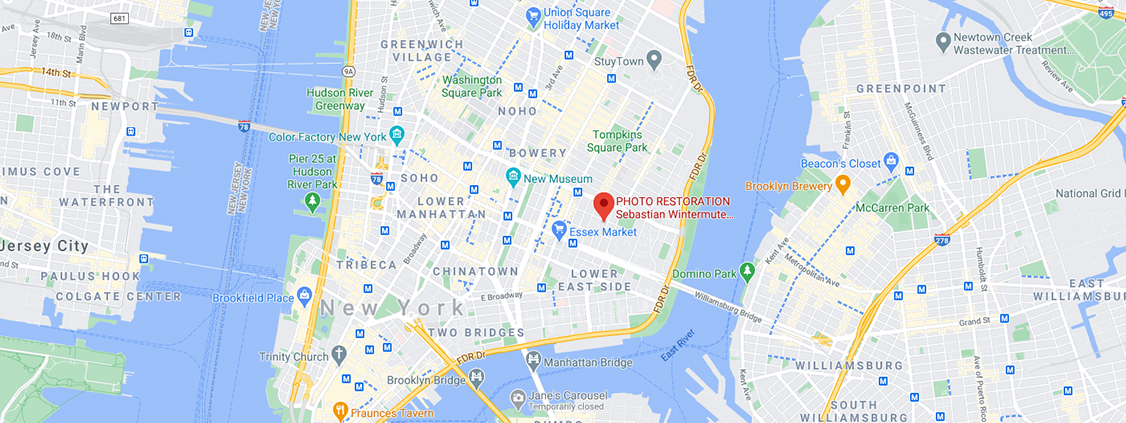
The studio is located on culturally vibrant Lower East Side of Manhattan. The proximity on the subway stations makes it easily accessible from Brooklyn and Queens as well as Midtown, Upper East and Upper West Side. Those living in East Village, Soho, Nolita and Chinatown, have only to walk for a few minutes to reach the location of the studio.
Many clients combine a visit to the studio with a shopping trip to many of designer boutiques on Stanton and Clinton Streets of the Lower East Side, brunch or diner at local restaurants or drinks at hot spots frequented by many celebrities.
You can arrange an appointment by contacting the studio by phone or e-mail.
195 Stanton Street,
New York, NY 10002
BUISSNESS HOURS :
Monday-Friday: 10am-7pm
Saturday: 10am-2pm
Nearest subway stations:
F, V - Houston & 1st Ave.
F, J, M, Z - Delancey & Essex Street
Bus:
9, 14A, 21 - Houston Ave.
New York Best Restoration Service | Photo Restoration | Document Restoration | Photo Retouching | New York Photo Scanning Service | Examples of Photo Restoration - Before and After | Photo Restoration Review and Client Testimonials | Photo Restoration Price List | Photo Restoration FAQ - How, What and Why? | Manhattan & Brooklyn Photo Restoration | Museum Quality Photo Restoration & Photo Reproduction |